Placement Experience at the International Institute for Integrative Sleep Medicine
Updated: Mar 13
-------
Adrian Pang
Placement Site: International Institute for Integrative Sleep Medicine (IIIS), University of Tsukuba, Japan

My placement was in Tsukuba, Ibaraki Prefecture, located some 50km northeast of the Tokyo metropolitan area. Home to many research and scientific institutions (such as JAXA, Japan’s space agency), Tsukuba is a city of education and innovation. It is a precious opportunity to be placed in a top-tier research institute like IIIS, which is designated under the Japanese World Premier International Research Center Initiative (WPI) and the Tsukuba Institute for Advanced Research (TIAR). Over six months, I fully immersed myself in the rich academic atmosphere at the University of Tsukuba while collaborating closely with my research group at IIIS and the Institute of Medicine.

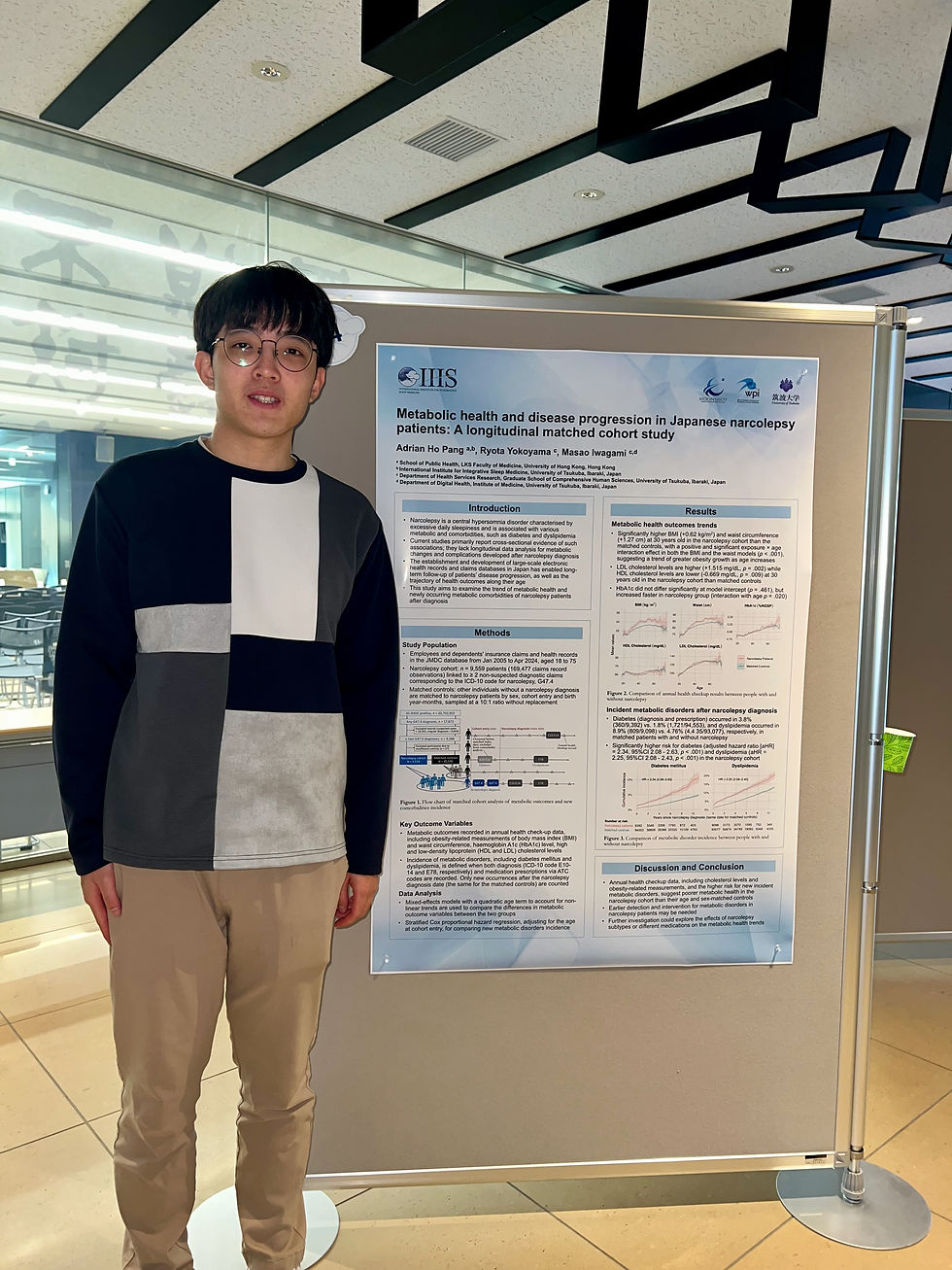
During my placement, I was responsible for implementing a prospective matched cohort study on the cardiometabolic health progression in narcolepsy patients. My study used a national epidemiological receipt database, covering inpatient and outpatient insurance claims, as well as dispensing and medical examination records. I was impressed by the close integration of various digital sources, including hospitals and pharmacies, personal health records and insurance companies. While we have the eHealth sharing platform in Hong Kong, it is a patient-oriented service enabling common access to health records across public and private healthcare providers. Like the nationwide database I analysed, the well-integrated digital infrastructure, together with the broad coverage of national or employment-based health insurance in Japan have enabled longitudinal follow-up research using such anonymised datasets. Findings from such studies could contribute to evidence-based decision-making and inform future public health strategies. This also highlights the importance of a robust health information system as one of the key building blocks in a health system.
In December, I had the opportunity to present my above research findings alongside postgraduate students and faculty staff at the 14th Annual IIIS Symposium. The whole day was filled with insightful seminars, with a keynote lecture on mouse neural circuits delivered by Prof. Liqun Luo, a highly decorated and internationally renowned neurobiologist from Stanford University. The symposium also featured studies conducted by principal investigators at IIIS and other globally prominent researchers. There was the data blitz session, in which each presenter was given one minute to summarise their project using one presentation slide. While there are many exciting aspects of my study that I would like to share, this short-format sharing helped me to learn to be concise in scientific communication, as well as to convey the most important findings in a limited amount of time. I also received lots of constructive feedback during the poster session, which is essential for me to further improve my research study before finalising it for publication.


IIIS presents itself, as the name suggests, as an international institute. Here at IIIS, faculty and students from different countries gather for their shared passion for sleep science and sleep medicine. During my six-month stay, I have met more international colleagues working or studying at the IIIS than anywhere else I travelled in Japan. It was nice to see how the Institute served as a hub for researchers from all around the world to contribute to the development of sleep science. The IIIS also presents an extremely friendly environment towards young researchers. Even as an undergraduate (which is a rare sight at the IIIS), I was entrusted with leading one of the weekly journal clubs attended by both faculty members and students at IIIS. This is usually hosted by a postdoc or a postgraduate student in one of the seventeen core labs. I was surprised by the fact that despite my inexperience, I was given this huge responsibility to present on behalf of my supervisor’s lab to professors and postgraduate students. It was a great learning experience for me, not only by giving the presentation itself, but also by taking part in the discussion that taught me more about critically appraising research findings.

We all know that sleep is an essential part of life, yet there are so many intricacies in its impact on other aspects of health, and underlying neurobiological mechanisms that remain a mystery. I am glad to have contributed even a tiny bit to this field during my placement at the IIIS. Working at a top-tier institute surrounded by renowned scholars in the field has certainly made me humbler along my journey as a researcher.
Lastly, I would like to thank my supervisor and his research group at Tsukuba for their close guidance and mentorship that made this placement such a rewarding journey.